


Sunday homily: Y'all come!
7 hours ago

One mishap for me unforeseeable, was the fact that the Williamson case has superimposed itself on the remission of the excommunication. The discreet gesture of mercy towards the four bishops ordained validly but not legitimately, suddenly appeared as something entirely different: as a disavowal of the reconciliation between Christians and Jews, and therefore as the revocation of what in this area the Council had clarified for the way for the Church. The invitation to reconciliation with an ecclesial group separating itself had thus become the opposite: an apparent way back behind all the steps of reconciliation between Christians and Jews which had been made since the Council and which to make and further had been from the outset a goal of my theological work. The fact that this superposition of two opposing processes has occurred and has disturbed for a moment the peace between Christians and Jews as well as the peace in the Church I can only deeply regret. I hear that closely following the news available on the internet would have made it possible to obtain knowledge of the problem in time. I learn from this that we at the Holy See have to pay more careful attention to this news source in the future. It has saddened me that even Catholics who could actually have known better have thought it necessary to strike at me with a hostility ready to jump. Even more therefore I thank the Jewish friends who have helped to quickly clear away the misunderstanding and to restore the atmosphere of friendship and trust, which - as in the time of Pope John Paul II - also during the entire time of my pontificate had existed and God be praised continues to exist.
Another mishap which I sincerely regret, is that the scope and limits of the measure of 21 January 2009 have not been set out clearly enough at the time of the publication of the procedure. The excommunication affects persons, not institutions. Episcopal consecration without papal mandate means the danger of a schism, because it calls into question the unity of the Bishops' College with the Pope. The Church must, therefore, react with the harshest punishment, excommunication, and that is to call back the persons thus punished to repentance and into unity. 20 years after the ordinations this goal has unfortunately still not been achieved. The withdrawal of the excommunication serves the same purpose as the punishment itself: once more to invite the four bishops to return.


BH: The story of King David is an iconic Old Testament story — were you raised in a very religious household?
MG: Not very religious. I was educated in a Jewish parochial school system. Known as yeshiva, but called by us — we called it Jew School. It’s very similar to (Catholic school) — the same as a lot of people on your site might know — but rabbis instead of nuns. My mom is Israeli, so she wanted me and my sibling to be conversant in the religion and culture.
BH: How long have you wanted to do this story?
MG: It’s a story that I’ve been interested in for a long time. The decision to pursue it came about two and a half years ago. I’d always thought it was something I’d have to do much later in life, when HBO would be willing to let me make it. I originally imagined it as a period piece, but then I thought, “Why wait?” — the TV audiences have grown so sophisticated in the last few years that with all the fantastic shows being done by HBO, by Showtime — you know, Lost, Alias, Heroes — all these shows have really brought up the level and audiences have grown so accustomed to, or so willing to, or so eager to dive into a story and to pick at its nuance. People treat The Wire like a novel, and it’s written like a novel and it rewards that deep viewing. And because of the great work done by all those shows, I felt like it was a fair time to try to tell this sort of novelistic story.
BH: I felt a kinship on some level between your show and HBO’s Rome . You get to do a modern re-telling of the story of King David. What made you decide not to do it as a period piece?
MG: Mostly, cost. It’s cost-prohibitive. It’s nearly impossible to do something accurately in a period piece. The reason Rome didn’t continue was because — it was absolutely brilliant, I thought it was a wonderful show — it was so costly that it couldn’t sustain itself, as I understand it. I could be guessing, but that’s what I’ve been told, that it never was able to gain the ratings required to justify its cost. And in order to do period in a way that isn’t silly, in a way that is authentic, it’s just incredibly costly. And plus, doing it period would have made it a much more accurate telling, and I was interested in taking the story and going further with it. You know, there’s a lot to draw from in the original text but not enough to sustain a hundred episodes of dialogue, let’s say. So by creating a ‘remove,’ and setting it in modern times, or with a modern aesthetic, anyway, we were free to continue interpreting. It was convenient. And the other thing was to make it really relatable to a modern America.
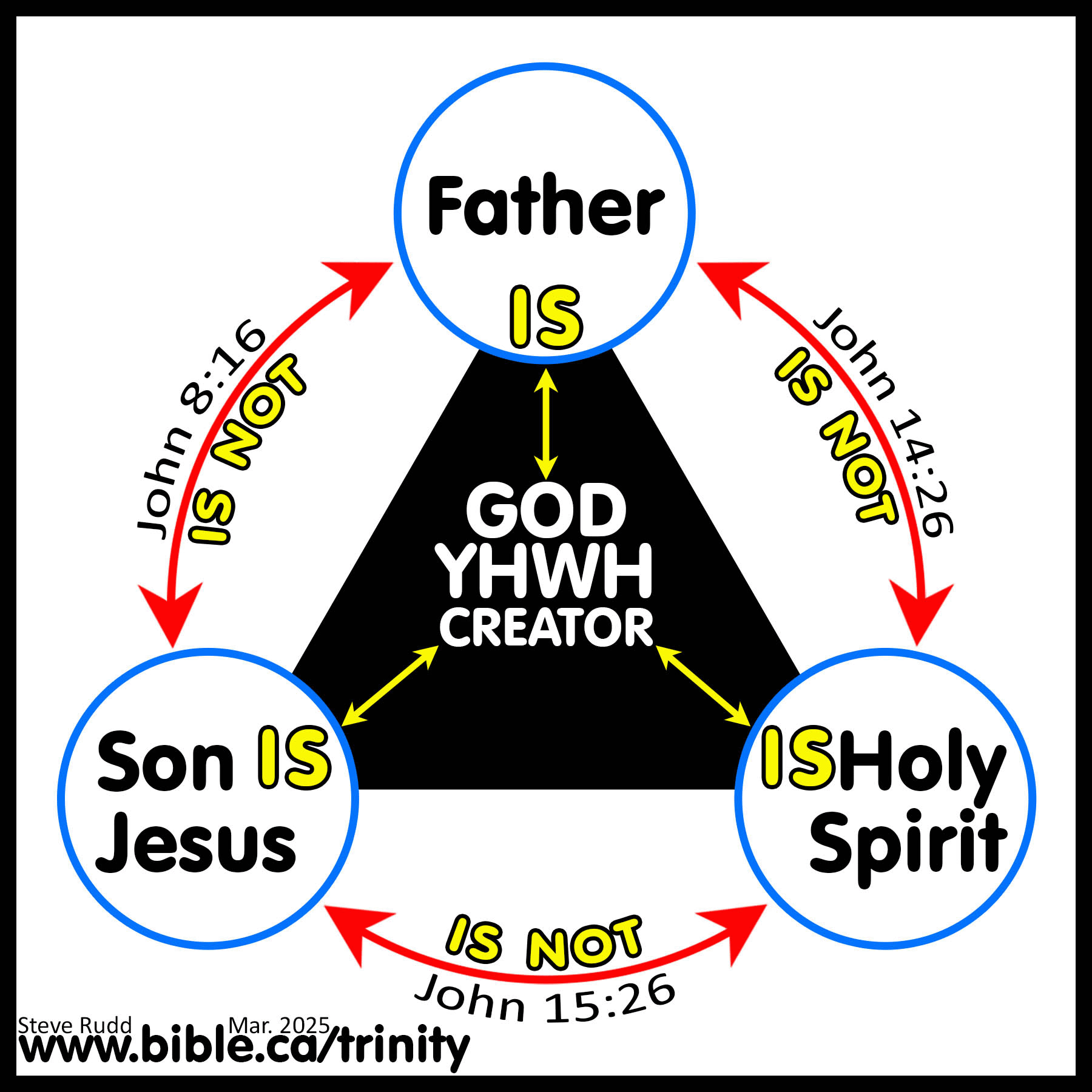
The Trinity can be thought of in these three expressions:
God is “beyond us.”
We can never really fathom what God is, but we know that He is far beyond our limited human nature or anything we can come to know in that human experience. God is the ultimate mystery, the question that we never fully answer. This is God the Father — the creator, the one who is beyond all understanding.
God is also “among us.”
We come to know God in the person of Jesus. God takes on our human nature and becomes “one of us.” Catholics also believe that this human experience of God continues in the sacrament of the Eucharist. God the Son is among us.
God is also “within us.”
God is the “divine spark” that awakens us to the fact that we are alive. God imbues us with our creativity, our gifts and talents, and our limitations as well. As we come to know ourselves as people, we also come to know God — who knows us better than we know ourselves. This is the experience of God the Holy Spirit.
God is all these things and more. We don’t know all that God is but this is how God has been revealed to us throughout the course of our history — how we have come to best express God.

Are women actually more “proud” than men? So women confess pride more often. Might it just be that women are more likely to think that their feelings of pride are sinful, whereas men think their feelings of pride are well-deserved and normal? My previous research has shown that women often downplay their accomplishments, because they feel culturally compelled to present themselves as demure and “sweet” — not strong and successful. This kind of socialization effect will carry over from the classroom to the bar to the confessional; it’s the way we are taught to operate. So a woman who gets an “A” on a test and thinks she’s da bomb for doing so might feel a twinge of guilt about her excitement, whereas a man would not.
Are men confessing to lust because they are conditioned to do so? I give talks to college students about dating and marriage, and you might be surprised that in the Q&A sessions, it’s the guys who do most of the talking. The men are quick to talk about their desire for a late night booty call to be answered in the affirmative, and what a “hook-up” really means in their circle of friends. After one such talk, it occurred to me that many think they are cool, attractive and more masculine for “confessing” those thoughts. I’m not saying that men are more lustful than women; I wonder how much our social conditioning impacts what we think to confess.

When I came to St. Sebastian in June 2002 I found this incredibly prescient stained glass window. It represents Our Lady of Woodside with the newly canonized Pope Saint Pius X and Asians, Africans, Europeans, and Native Americans all united under her mantle. In 1955 when the church opened, only the European Immigrants would have been in the mind of any artist other than one guided by the Holy Spirit. Today, the images on the glass depict the Woodside community and the parish of St. Sebastian.
Fifteen percent of respondents said they had no religion, an increase from 14.2 percent in 2001 and 8.2 percent in 1990, according to the American Religious Identification Survey.
Northern New England surpassed the Pacific Northwest as the least religious region, with Vermont reporting the highest share of those claiming no religion, at 34 percent. Still, the study found that the numbers of Americans with no religion rose in every state.
''No other religious bloc has kept such a pace in every state,'' the study's authors said.
In the Northeast, self-identified Catholics made up 36 percent of adults last year, down from 43 percent in 1990. At the same time, however, Catholics grew to about one-third of the adult population in California and Texas, and one-quarter of Floridians, largely due to Latino immigration, according to the research.
Nationally, Catholics remain the largest religious group, with 57 million people saying they belong to the church. The tradition gained 11 million followers since 1990, but its share of the population fell by about a percentage point to 25 percent.
Christians who aren't Catholic also are a declining segment of the country.


"Oh shit, it's Ash Wednesday! I forgot. And now I just cursed--I'm off to a great start." - Random person on the street
"It's Ash Wednesday...cool, what are you giving up?" - Woman buying a soda
"Nice Ash!" - my friend, Melissa.
"If someone smudges their ash and makes it look like an upside down cross would that make it Ash-backwards?" - an old friend who requests to stay anonymous
"Ugh...I hate Ash Wednesday. It's a silly superstition." - drunk woman who did in fact, have ashes on her head.
"Excuse me, you've got some kind of black crap on your forehead."
Me: "Nah dude, It's Ash Wednesday!"
Guy: "Huh?"
Me: (Louder) "It's Ash Wednesday!"
Guy (obviously taken aback: "Oh! Oh!...I didn't know that!"
Me (realizing I sounded harsh): "Thanks for looking out for me anyway, man."
Guy: "No problem. I thought I saw a bunch of people with stuff on their head but then I thought I was just seeing floaters!"


